
English
English
Appearance
The Tsar Bomba, tested by the Soviet Union in 1961, had a yield of about 50 megatons. The Little Boy bomb used on Hiroshima in 1945 had about 15 kilotons. That makes the Tsar Bomba about 3,300 times more powerful. Compare their blast rings at true scale on the map below.
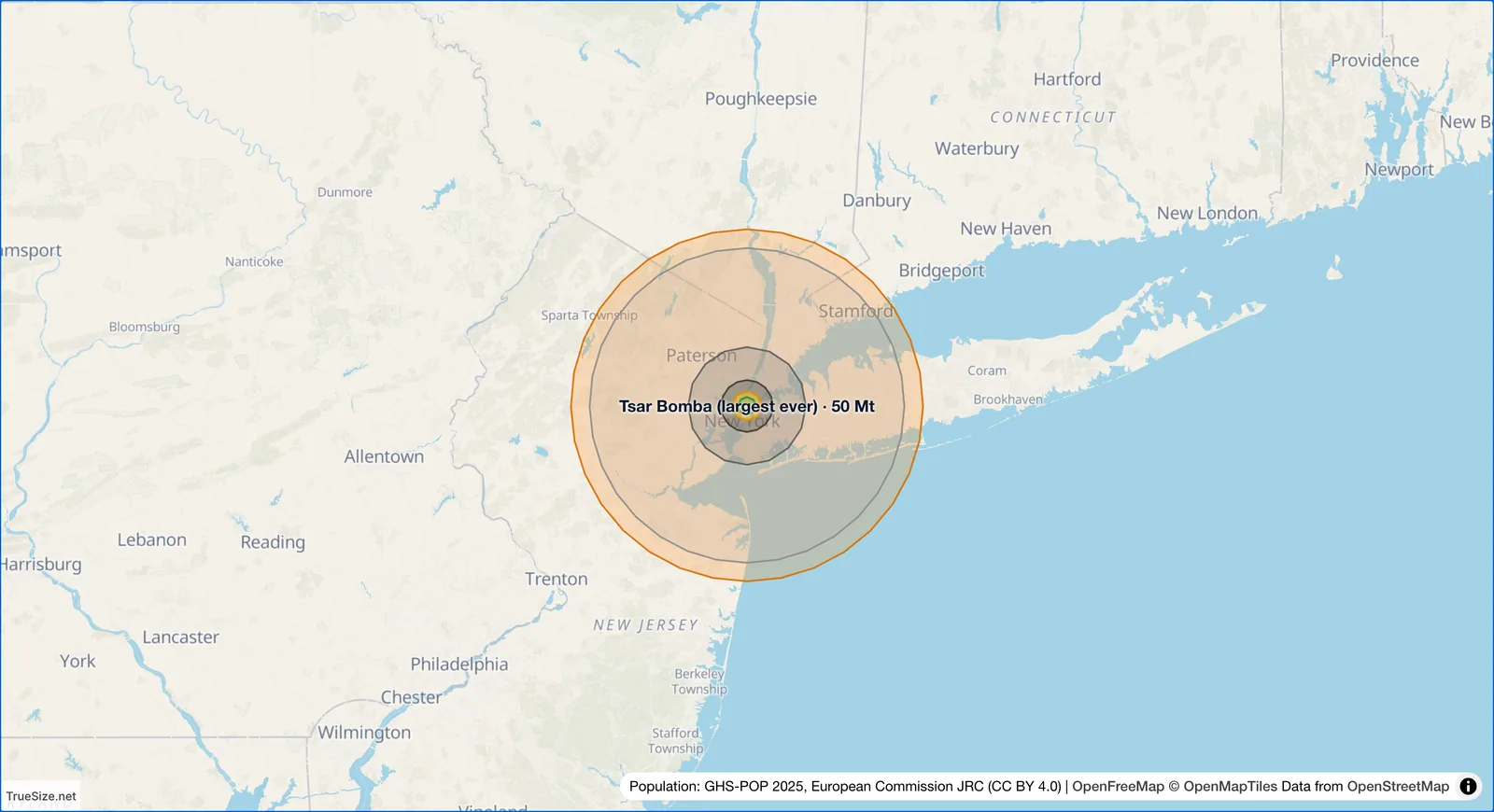
Blast rings of the Tsar Bomba at true size.
| Weapon | Year | Yield | Status |
|---|---|---|---|
| Little Boy | 1945 | 15 kt (estimates range from 13 to 16 kt) | Used in war |
| Tsar Bomba | 1961 | 50 Mt (50,000 kt) | Test |
| Tsar Bomba, full design | never | 100 Mt | Never built |
Blast distance grows with the cube root of the yield, so the Tsar Bomba's blast rings are roughly 15 times wider than Little Boy's.
Little Boy was a gun-type uranium bomb dropped on Hiroshima on August 6, 1945. The Tsar Bomba was a three-stage thermonuclear device dropped from a modified Tu-95 bomber over Novaya Zemlya, an Arctic archipelago, on October 30, 1961. Its uranium tamper was replaced by lead to limit fallout and halve the yield; the original design would have given about 100 Mt but was never built. Its flash was visible more than 1,000 km away. The tool lists the sources for each yield; yield figures for historical weapons are estimates.
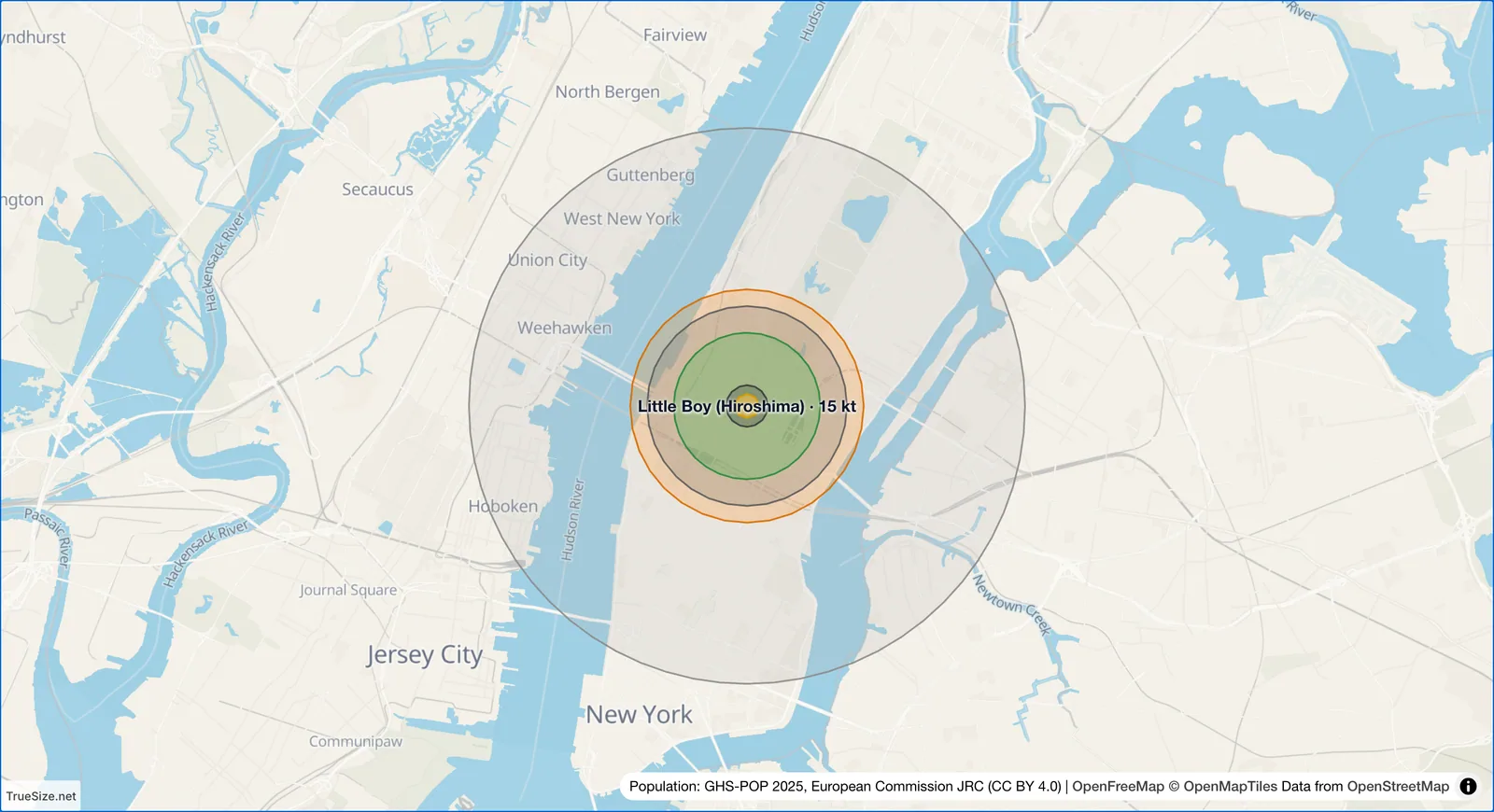
The same view for Little Boy.
TrueSize draws one ring for each effect of a single detonation in clear weather:
A surface burst also adds a fallout plume downwind. The ring distances use published effects formulas (Glasstone and Dolan, 1977, and others), so they are approximations. Real effects depend on terrain, weather, burst height and buildings.
A weapon's reach is often quoted as a radius in kilometers or miles, which is hard to picture. Drawing the rings on the map at true size lets you see which streets, districts and cities lie inside each one, without map distortion. The Tsar Bomba's outer rings span many tens of kilometers, while Little Boy's are just a few. The tool can show estimated casualty ranges for places with population data, with the note that they are rough estimates and leave out many factors. This page makes no claim about what would happen to any real place.
Please rotate your device
The map needs portrait orientation on small screens — landscape leaves too little height to work with.