
English
English
Appearance
The Nukes tool in TrueSize draws the estimated reach of a nuclear detonation as rings on the map, so you can see how far each effect would extend over a place you know. It includes 29 weapon presets, from the tiny Davy Crockett to the 50-megaton Tsar Bomba, and a custom yield from 0.001 to 100,000 kilotons. It is an educational tool built on published government effects methods.
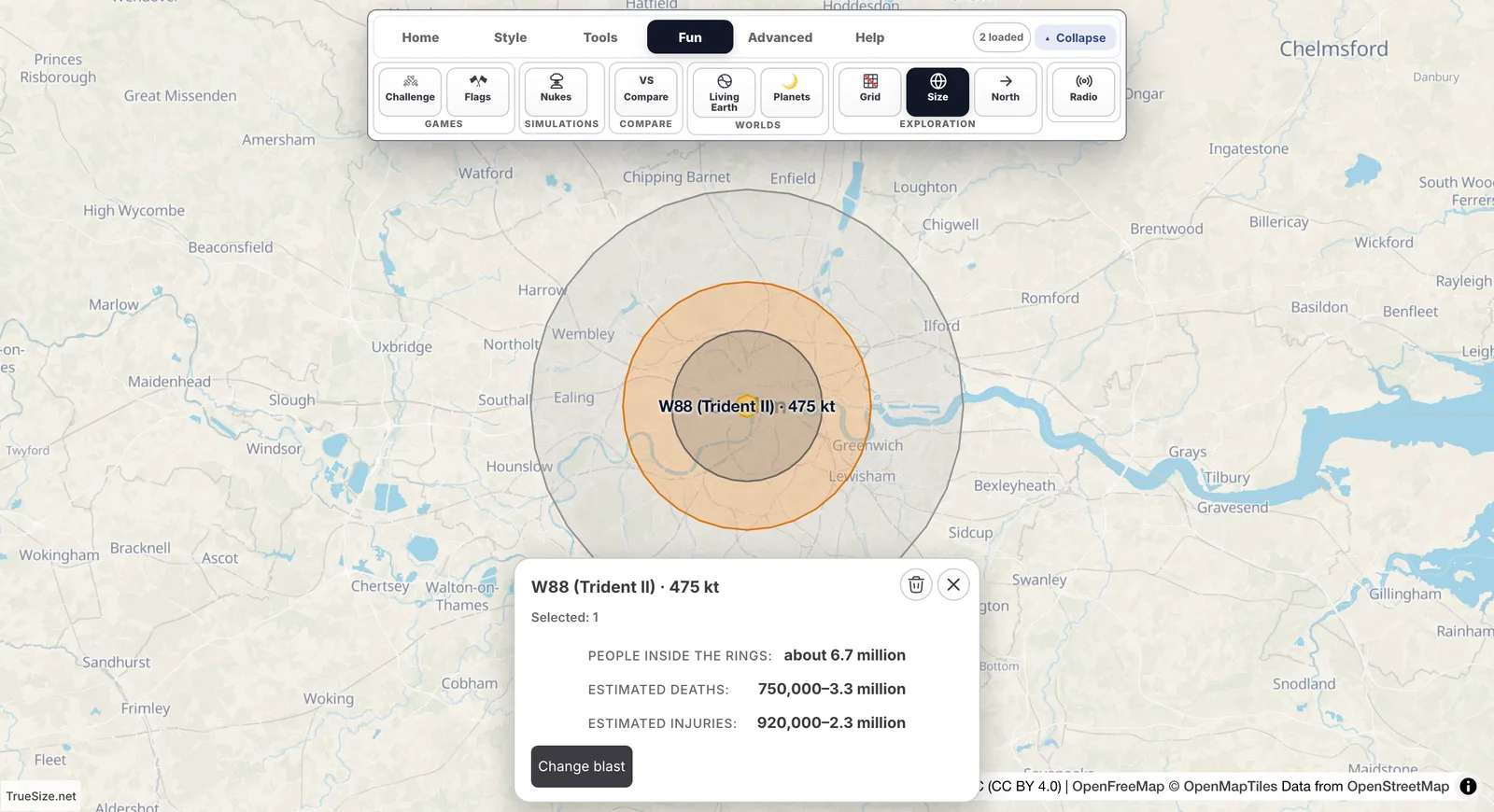
Blast, thermal and radiation rings for one detonation, drawn at true scale.
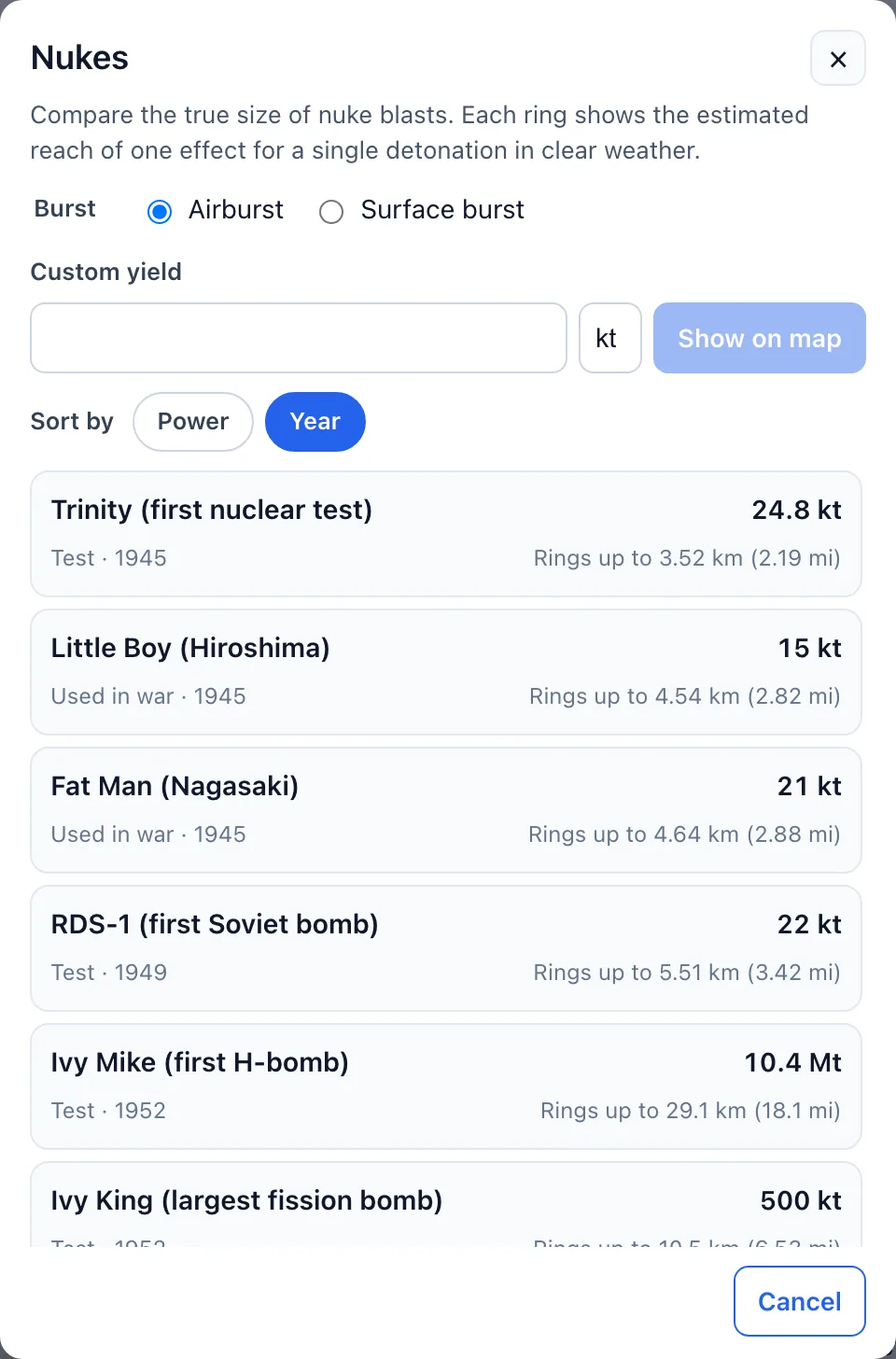
The weapon list. Sort it by Power or Year.
Each ring shows the estimated reach of one effect for a single detonation in clear weather.
| Ring | What it shows |
|---|---|
| Fireball | The fireball at its largest; anything inside is exposed to extreme heat |
| Heavy blast (20 psi) | Heavy concrete buildings are severely damaged or demolished; few people survive |
| Radiation (500 rem) | Without medical treatment, half or more of the people exposed die within weeks |
| Buildings collapse (5 psi) | Most residential buildings collapse; injuries are universal and deaths widespread |
| 3rd-degree burns | Burns through all layers of exposed skin; often fatal without care |
| Windows break (1 psi) | Windows shatter; many people are injured by flying glass |
| Fallout plume | Dose rate one hour after the burst, carried downwind (surface bursts only) |
The effects are different for every yield. In general, the light-damage and burn rings grow much larger than the fireball, which is why a large weapon affects an area far bigger than most people expect.
| Weapon | Yield | Year | Note |
|---|---|---|---|
| Davy Crockett | 0.02 kt | 1962 | Smallest US warhead, now retired |
| Little Boy | 15 kt | 1945 | Used in war on Hiroshima |
| Fat Man | 21 kt | 1945 | Used in war on Nagasaki |
| Trinity | 24.8 kt | 1945 | First nuclear test |
| W76-1 | 90 kt | 2008 | Trident II warhead, in service |
| W88 | 475 kt | 1989 | Trident II warhead, in service |
| B83 | 1,200 kt | 1983 | Largest US bomb in service today |
| Ivy Mike | 10,400 kt | 1952 | First hydrogen bomb test |
| Castle Bravo | 15,000 kt | 1954 | Test at Bikini Atoll |
| Tsar Bomba | 50,000 kt | 1961 | Largest weapon ever detonated |
| Tsar Bomba, full design | 100,000 kt | 1961 | Never built |
Each preset is labeled Used in war, Test, In service, Retired or Never built. Where a real test was underground, the rings show the same yield above ground, and the dialog says so. The full list also includes warheads and tests from several countries; each entry cites its sources.
Open Nukes again, pick another weapon and click the map: both blasts stay on the map, so you see them at the same scale. The comparison of the smallest wartime weapon with the largest test ever is on the Tsar Bomba vs Little Boy page.
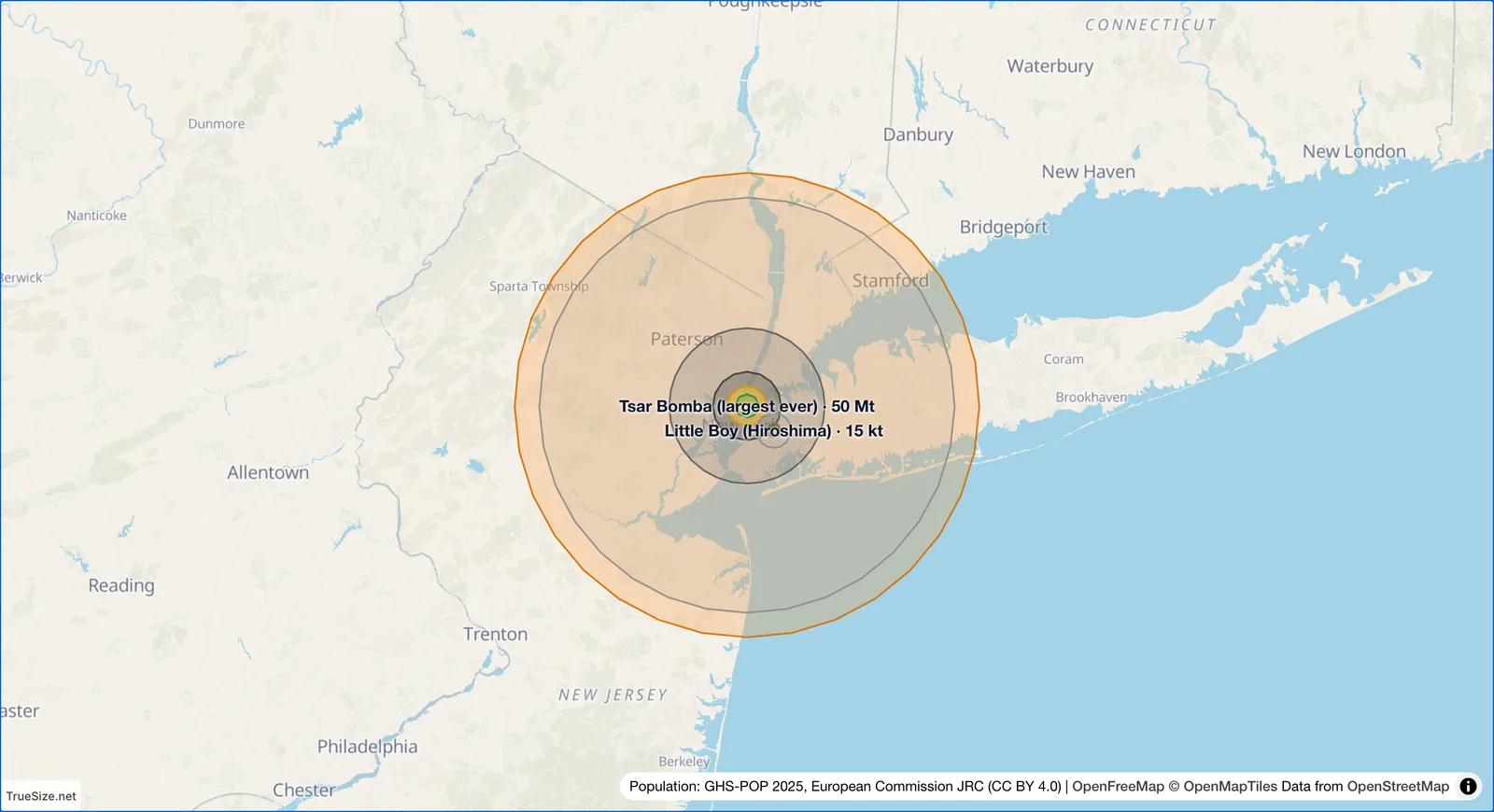
Tsar Bomba (50 Mt) and Little Boy (15 kt) at the same scale.
TrueSize also shows People living inside the rings and an Estimated casualties section with a range of deaths and injuries. The estimate combines two published methods and reports both as a range:
The number of people inside each ring comes from the GHS-POP 2025 population grid of the European Commission's Joint Research Centre.
This is an estimate, not a prediction. The models leave out fallout, later deaths, shelter, warning time and the time of day, so real numbers could be lower or higher. TrueSize shows them only to give a sense of scale.
The ring distances use the public US government methods in Glasstone and Dolan, The Effects of Nuclear Weapons (1977), and Fletcher and others (1963), with fallout scaling from US civil-defense research reports. The dialog lists the effects sources under Sources, and every weapon entry links to references such as Wikipedia articles on the weapon or test.
The Nukes tool works on the web and in the TrueSize mobile app. It is not available while a planet is shown.
Next: Map styles and skins
Please rotate your device
The map needs portrait orientation on small screens — landscape leaves too little height to work with.