
English
English
Appearance
Planet mode in TrueSize lets you put any country on the Moon, Mars, Pluto or another world and see how big it really is there. Regions keep their true Earth area, so the United States covers about a quarter of the Moon's whole surface but only a sliver of Saturn. There are 10 worlds to choose from.
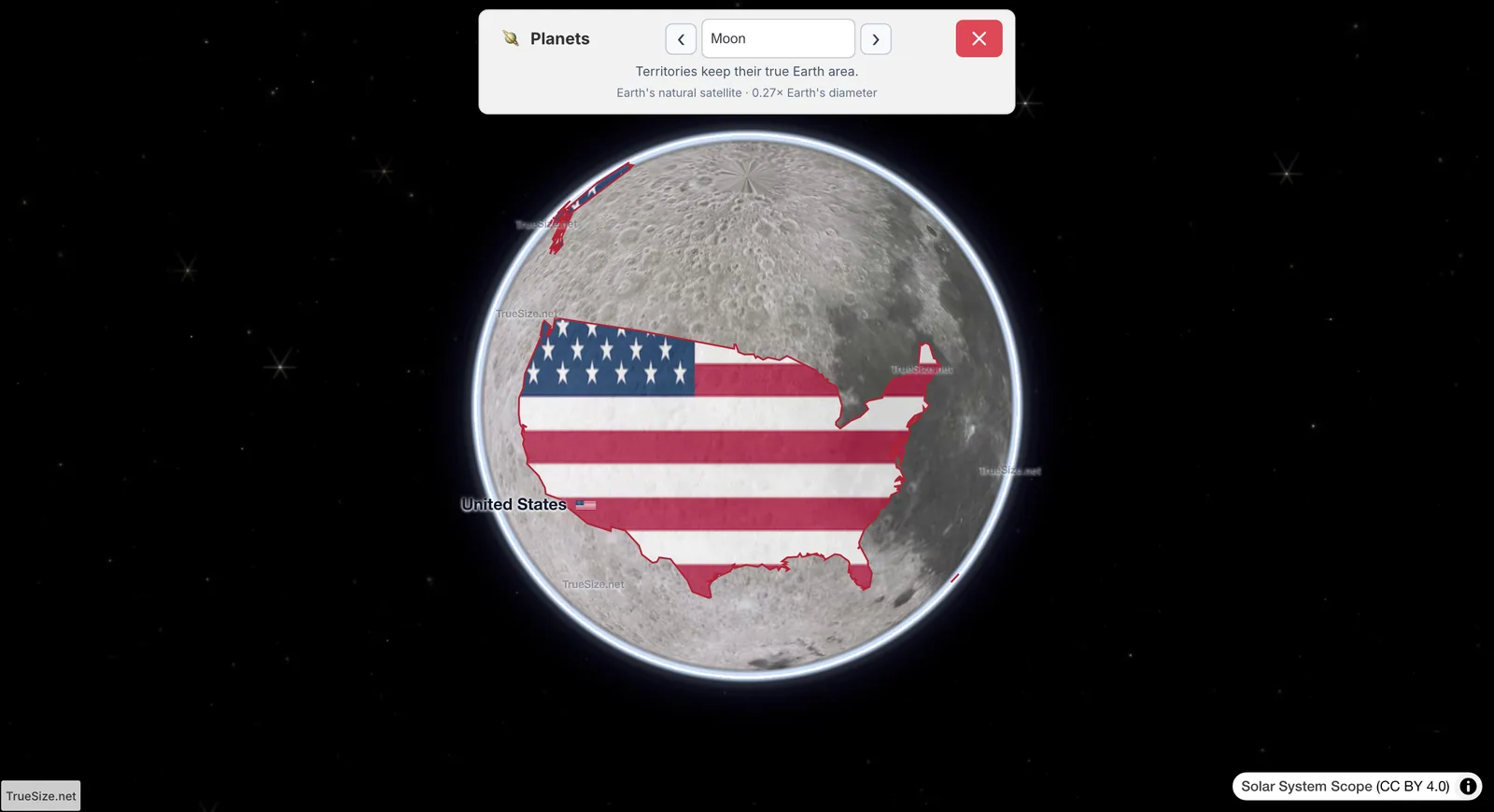
The United States on the Moon, at its true area.
Open the map at truesize.net and load one or more countries.
Load and arrange your regions first: Divide, Merge, the timeline and the Style, Tools and Advanced tabs are switched off while a planet is shown.
Go to the Fun tab and press Planets.
Under "Choose a world", pick the Moon, Mars or any other world. The map switches to that world's surface.
Drag the countries around the surface. Zoom in and out as usual.
Use the ‹ and › buttons beside the picker to step to the previous or next world.
Press Return to Earth to go back.

The picker header with Previous, Next and Return to Earth.
The panel reminds you: "Territories keep their true Earth area." If a country is very big on a small world, or sits near a pole, you may see a note that it looks distorted and its shown area may be approximate.
The United States at true size on every world, from Mercury to Pluto.
The area of each world is calculated from its radius (4πr²). The last column shows how much of that surface the United States (about 9.83 million km²) would cover.
| World | Radius (km) | Diameter vs Earth | Surface area | The USA covers |
|---|---|---|---|---|
| Moon | 1,737.4 | 0.27× | 37.9 million km² | about 26% |
| Mercury | 2,439.4 | 0.38× | 74.8 million km² | about 13% |
| Venus | 6,051.8 | 0.95× | 460 million km² | about 2.1% |
| Mars | 3,389.5 | 0.53× | 144.4 million km² | about 6.8% |
| Jupiter | 69,911 | 10.97× | 61.4 billion km² | about 0.016% |
| Saturn | 58,232 | 9.14× | 42.6 billion km² | about 0.023% |
| Uranus | 25,362 | 3.98× | 8.08 billion km² | about 0.12% |
| Neptune | 24,622 | 3.86× | 7.62 billion km² | about 0.13% |
| Pluto | 1,188.3 | 0.19× | 17.7 million km² | about 55% |
| Sun | 695,700 | about 109× | 6.08 trillion km² | about 0.00016% |
For comparison, Earth's surface is about 510 million km², and its land is about 148.9 million km². Earth's land area is almost the same as the whole surface of Mars.
Russia on Mars: Russia (about 17.1 million km²) covers roughly 12% of Mars.
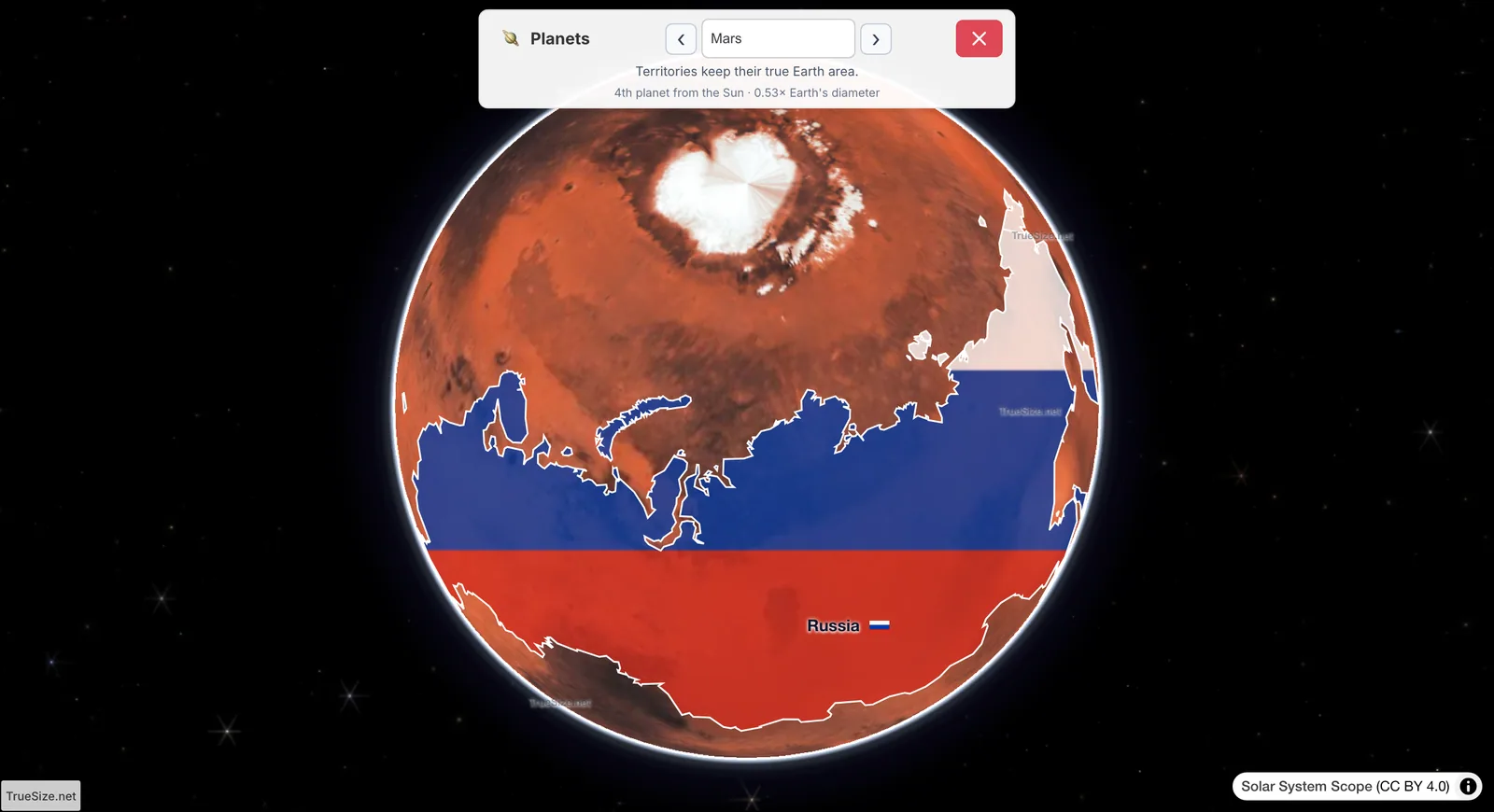
Russia on Mars.
The USA on Pluto: the dwarf planet's whole surface is about 17.7 million km², so the United States alone covers more than half of it. The Soviet Union (about 22 million km² in the timeline) was bigger than all of Pluto. To try it, load the Soviet Union in Historical mode (Home → Modern/Historical, Go to year 1960), pin it, then open Planets.
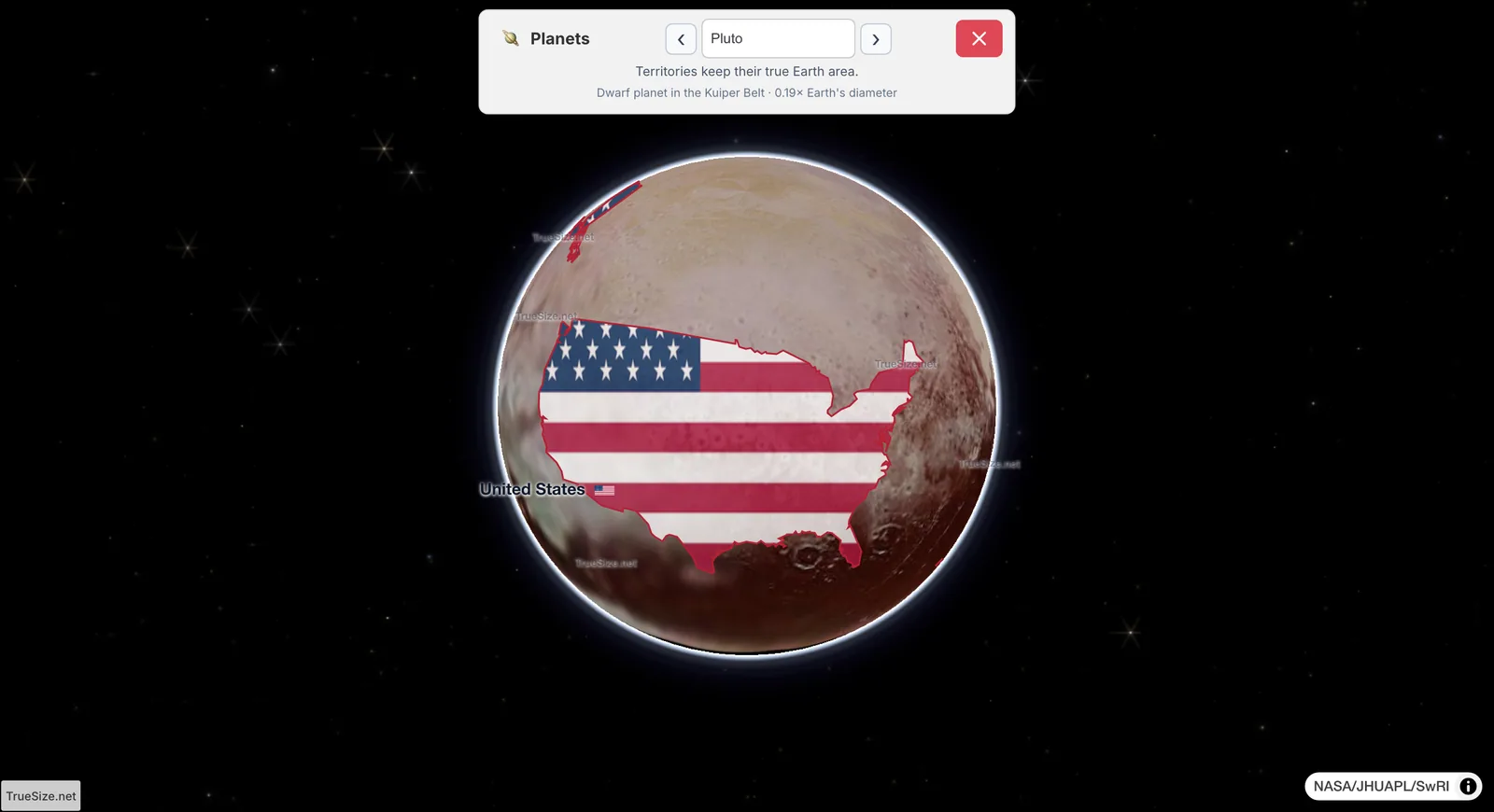
The United States on Pluto.
A region that is close to or larger than the world it sits on cannot be drawn without overlapping itself. TrueSize then shows a note that the region may look distorted and that its shown area is approximate.
The USA on Saturn: on a gas giant the same country is a tiny dot.
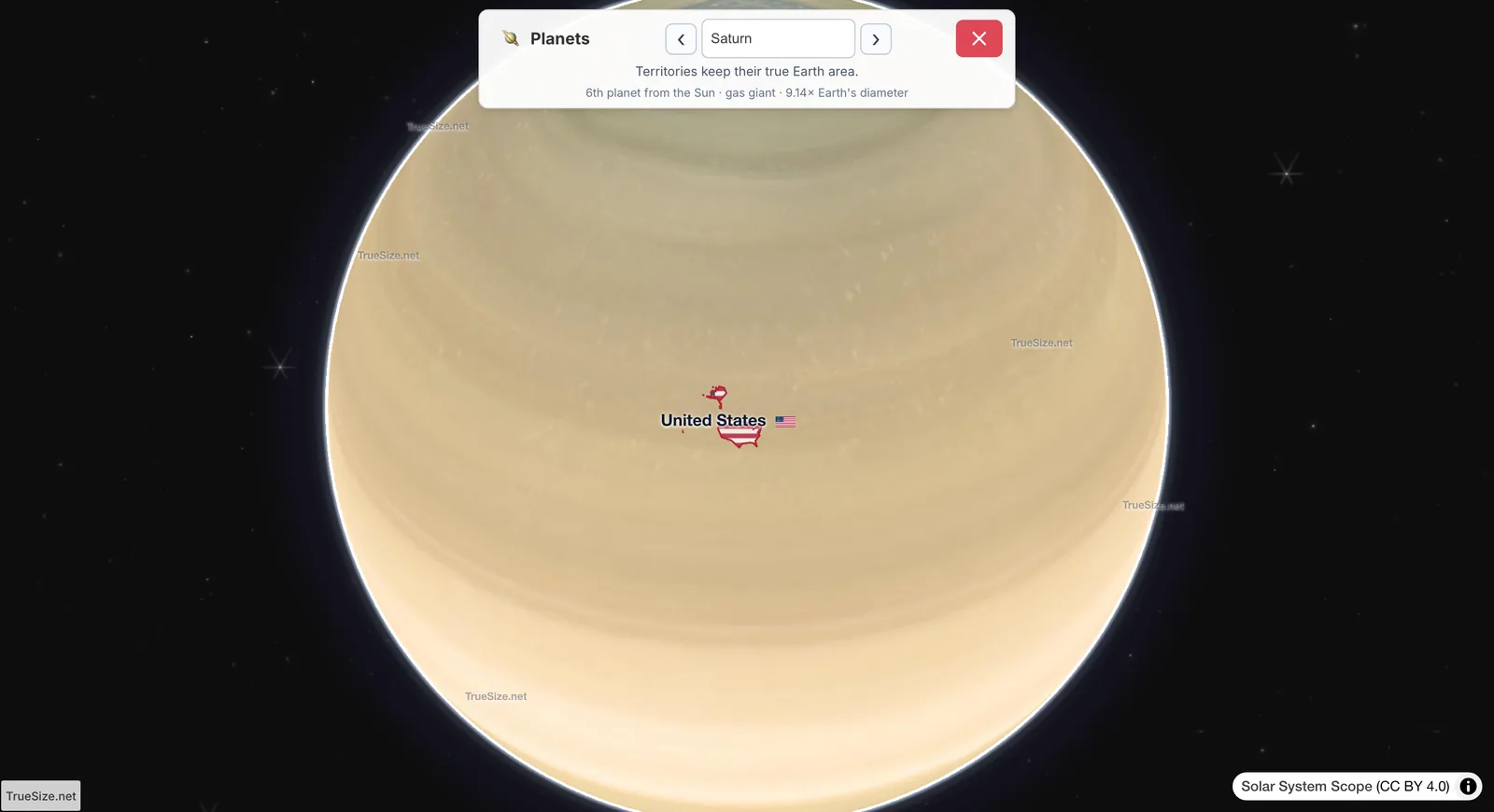
The USA on Saturn, barely visible.
While a planet is shown, the address bar holds a link to this view. Copy it from the address bar to send someone the exact planet map. See Share your map and export it.
Planet mode is available on the web only. The mobile app does not include it.
Please rotate your device
The map needs portrait orientation on small screens — landscape leaves too little height to work with.