
English
English
Appearance
On Saturn the USA would cover only about 0.023% of the planet, and on Jupiter just 0.016%. Saturn's surface is about 4,300 times the area of the USA, and Jupiter's is about 6,200 times. Placed on either gas giant at true size, the United States becomes a tiny speck.
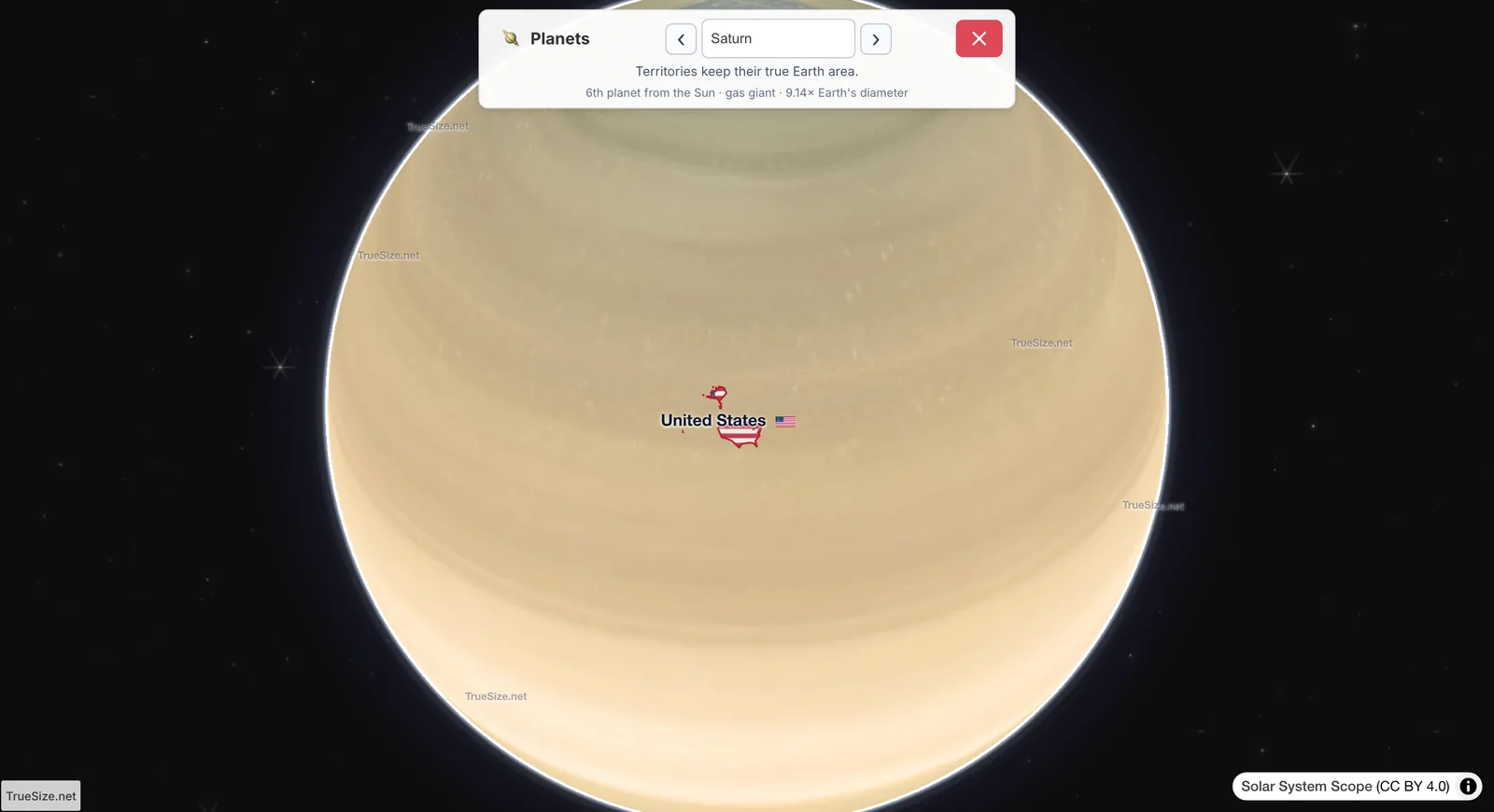
The USA on Saturn in TrueSize.
| World | Radius | Diameter vs Earth | Surface area | USA covers |
|---|---|---|---|---|
| Saturn | 58,232 km | 9.14 times | about 42.6 billion km² | about 0.023% |
| Jupiter | 69,911 km | 10.97 times | about 61.4 billion km² | about 0.016% |
| Earth | 6,371 km | 1 | about 510 million km² | about 1.9% |
The surface area is calculated from the radius. The USA is about 9.83 million km² (a well-known published total). Africa would cover about 0.07% of Saturn and about 0.05% of Jupiter.
Jupiter and Saturn are gas giants and have no solid ground. TrueSize shows the cloud tops, and the area is the area of that visible sphere. The same applies to Uranus and Neptune. Their images come from Solar System Scope textures (CC BY 4.0).
The Sun is even larger. Its diameter is about 109 times Earth's, and the USA would cover about 0.00016% of its photosphere.
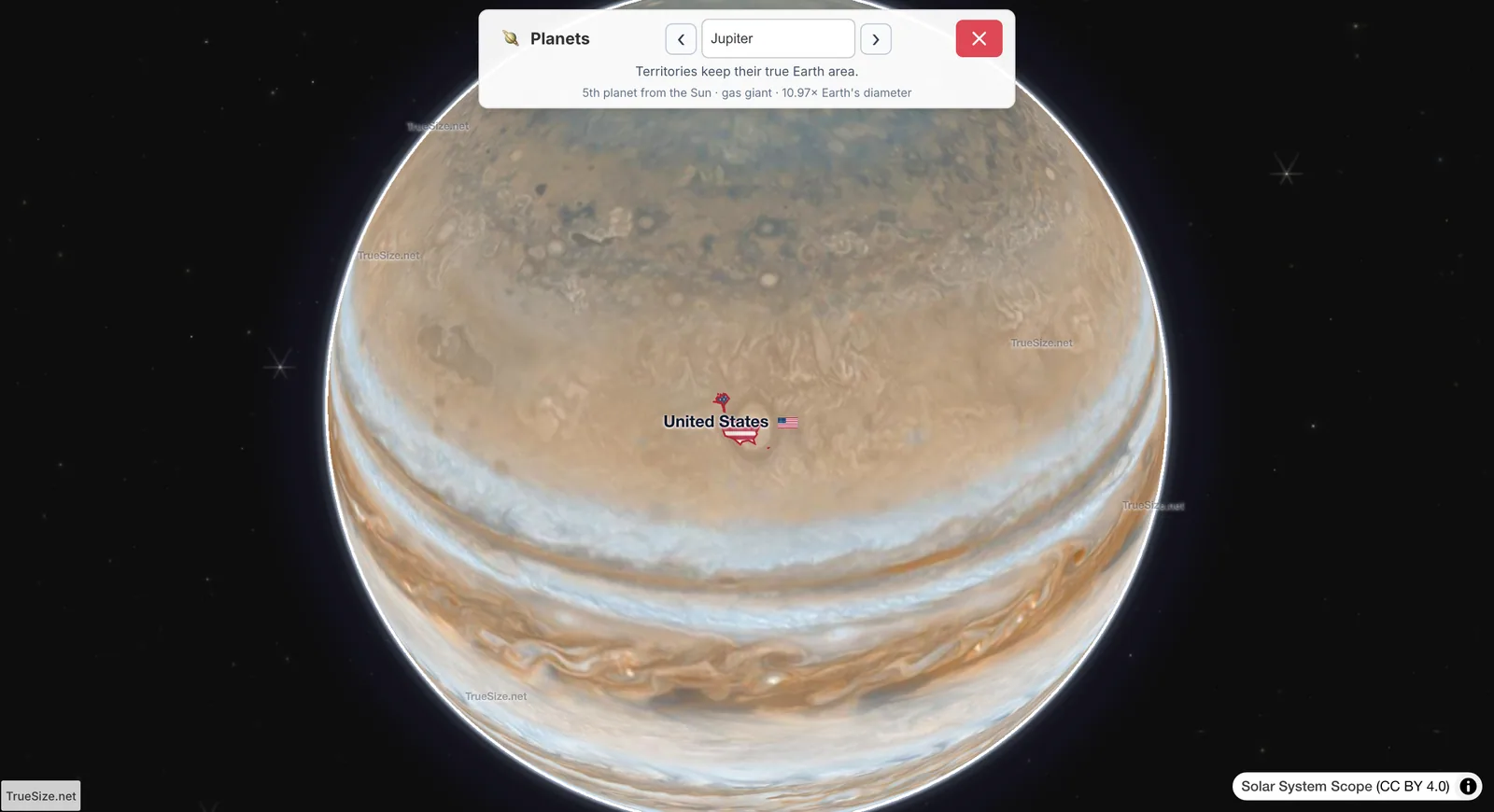
The USA on Jupiter: about 0.016% of the planet.
Open the Jupiter map in TrueSize
Surface area grows with the square of the radius. Jupiter is about 11 times as wide as Earth, so its surface is about 120 times Earth's. A country moved onto it keeps its real area, so it ends up looking minuscule. You may need to zoom in to see it at all.
Planet mode works on the web version only. Use Return to Earth to go back.
Please rotate your device
The map needs portrait orientation on small screens — landscape leaves too little height to work with.