
English
English
Appearance
More than half of the world's people live inside a circle with a radius of about 4,000 km centered near Yuxi in southern China. Measured in TrueSize with GHS-POP 2025 data, a 3,995 km circle around Yuxi, Yunnan (24.4°N, 102.5°E) holds about 4.4 billion people, more than half of the world's 8.2 billion. Yet the circle covers only about 9.5% of Earth's surface.
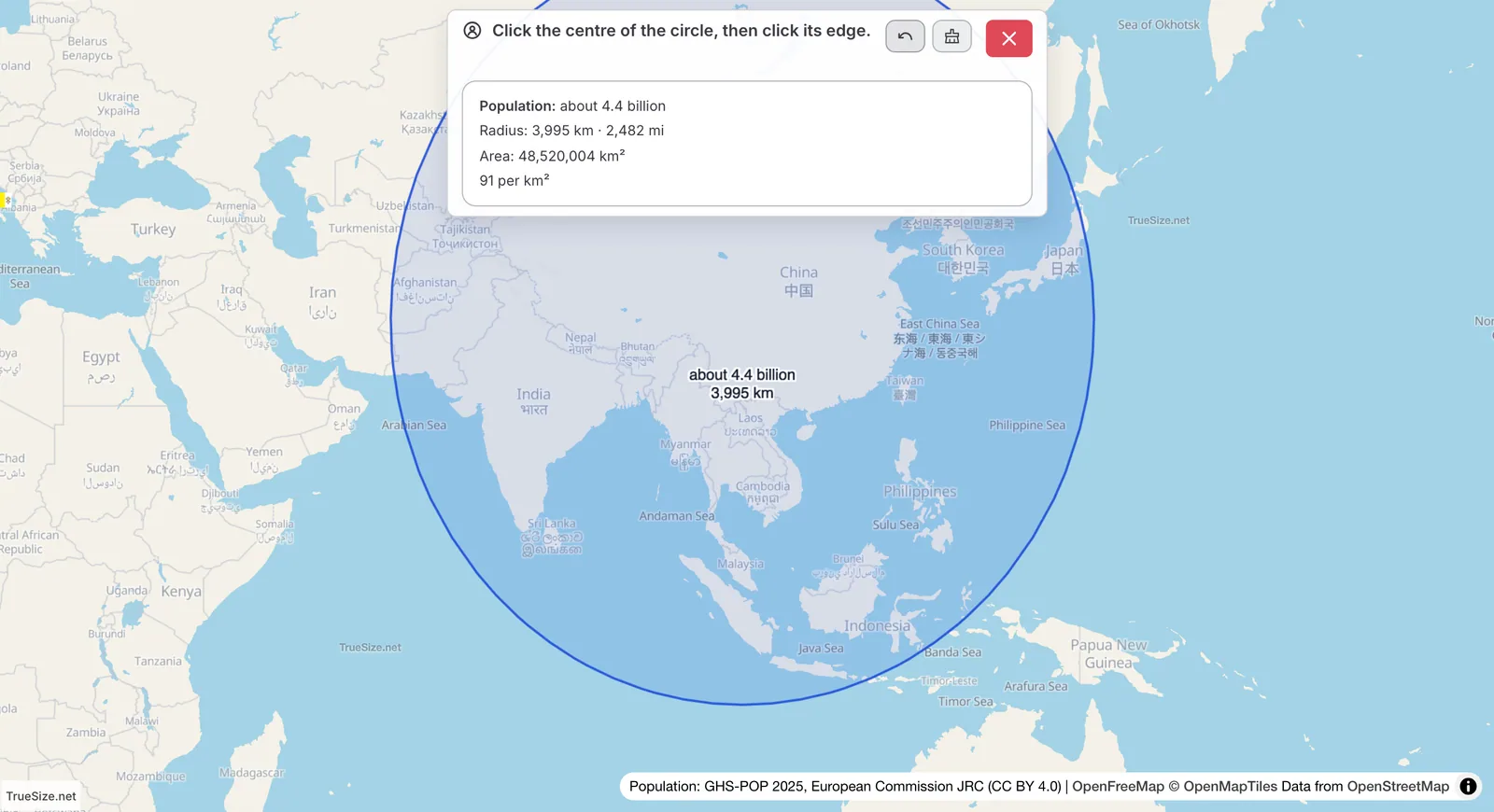
A 4,000 km circle centered near Yuxi in southern China, with its population count.
The circle is known as the Valeriepieris circle, after the Reddit user name of Ken Myers, who posted it in 2013. Danny Quah of the London School of Economics later examined the idea. Work by the map maker Alasdair Rae tested about 1,500 candidate circles and found the best center to be near Yuxi in Yunnan, China. In TrueSize, a circle with a radius of 3,995 km around that point holds about 4.4 billion people.
The circle is not magic. It simply shows how unevenly people are spread: much of Earth is ocean, desert, mountain or ice, and much of Asia is densely populated. Depending on the exact center, the circle takes in most of China, Southeast Asia, Bangladesh, Korea and eastern India. Whether a place is inside depends on the exact center, so different tools give slightly different counts.
| Measure | Value (about) |
|---|---|
| Radius | 3,995 km (about 4,000 km) |
| Area of the circle | 48.5 million km² (about 9.5% of Earth's surface) |
| Share of world population inside | more than 50% (about 4.4 of 8.2 billion in 2025) |
| People inside, from TrueSize | about 4.4 billion (about 91 people per km²) |
Sources: Valeriepieris circle on Wikipedia and the GHS-POP 2025 population grid (European Commission JRC, CC BY 4.0).
A Mercator map makes Russia, Canada and Scandinavia look huge, but they hold few people. The crowded part of the world sits closer to the equator, where the map makes land look small. The circle in TrueSize is drawn on the sphere, so its radius is the same in every direction on the real Earth.
Circles are not saved in share links, so you need to draw this one yourself.
Move the center around to see how the count changes. Try a circle of the same radius over Europe, Africa or North America.
Please rotate your device
The map needs portrait orientation on small screens — landscape leaves too little height to work with.