
English
English
Appearance
Can you divide a country into two halves with the same number of people? In Split the People you draw one straight line through a real place. TrueSize then counts the people on each side, raises the population from the map as 3D columns, and tells you how close you came to an even 50/50 split.
It is harder than it sounds. A line through the middle of the map rarely splits the population, because people gather in cities, along coasts and in river valleys. To play well you need to know where people actually live.
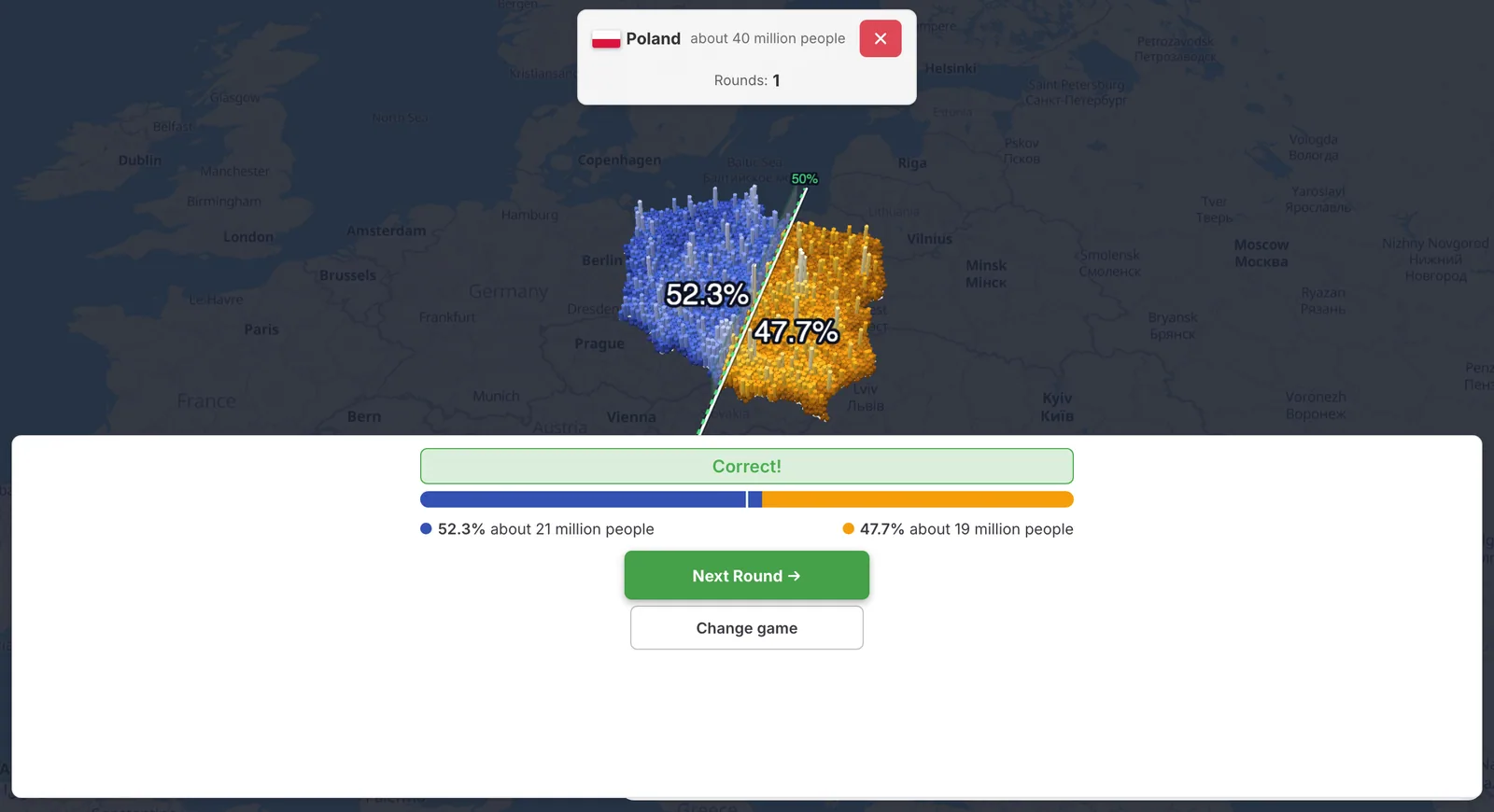
After your cut, the people of each side rise from the map in blue and amber.
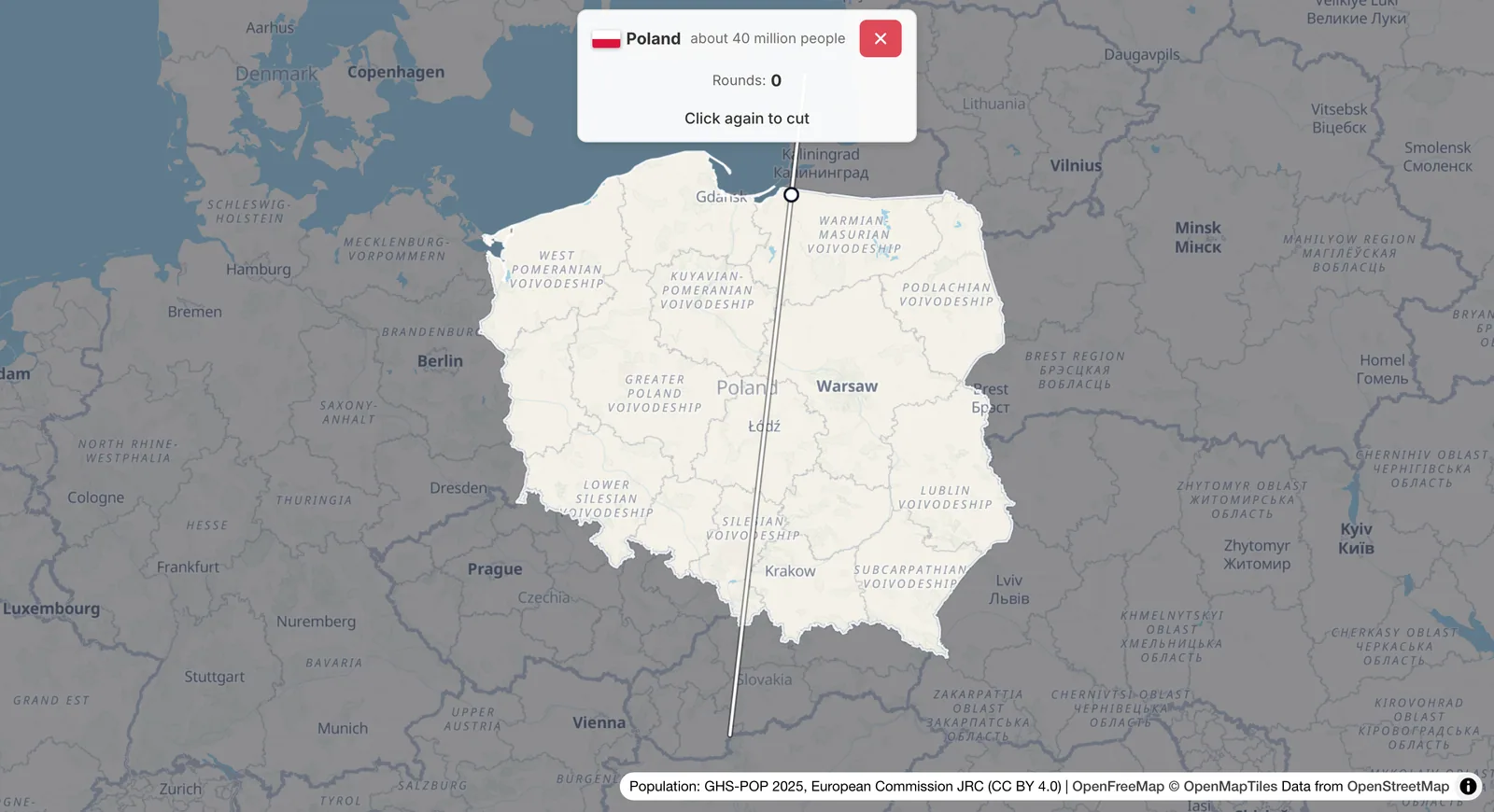
Aiming: the rest of the world is dimmed and the line follows your cursor.
| Off from 50/50 | Result |
|---|---|
| 0.5% or less | Perfect! |
| Up to 5% | Correct! |
| Up to 10% | Close! |
| More than 10% | Not quite! |
If your line misses the people completely, the game asks you to try again and the round continues.
Choose how large the places are before you start.
| Option | What you get |
|---|---|
| Countries | Any country with at least 20,000 people |
| States and provinces | The first level inside a country |
| Counties and districts | The second level inside a country |
| Cities and towns | Smaller places with at least 1,000 people |
The levels follow each country's own subdivisions, so a "county" in one country can be larger than a "state" in another.
The people are counted from the GHS-POP 2025 population grid by the European Commission's Joint Research Centre, with cells down to about 250 m. People are counted where they live, so the total can differ a little from a country's official figure. Very small places are left out, because a few grid cells are not enough for a fair cut.
The Population tool shows these 3D columns for any circle you draw or any region on your map, with nothing to score.
Split the People works on the web, in a desktop or phone browser. Open it directly with truesize.net/#split.
Next: Keyboard Shortcuts
Please rotate your device
The map needs portrait orientation on small screens — landscape leaves too little height to work with.