Skip to content
Ads keep this site free 🙏

World Languages Map: Where Languages Are Spoken ​

TrueSize includes a world languages map with 4,345 language areas, 281 language families and 184 official-language areas. Search for a language such as Swahili or Quechua, or load them all, then move the shapes around to compare them with countries at true size. The areas are approximate, so treat them as a guide and not a border.
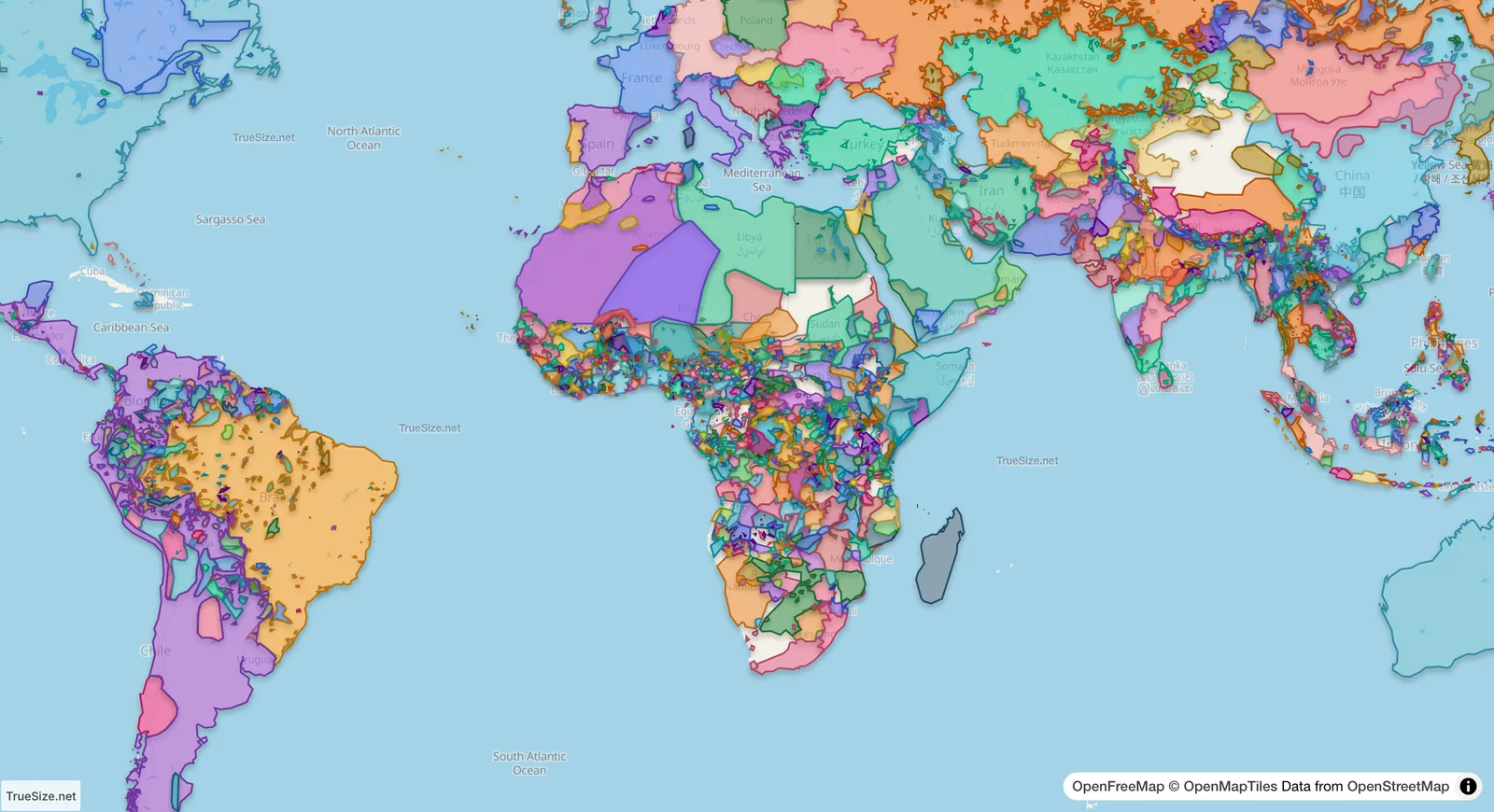
World languages map with every language area loaded in TrueSize

Every language area loaded at once.

How to find a language ​

  1. Open the map at truesize.net.
  2. On the Home tab, type a language name in the search box.
  3. Pick the language from the results. Its area appears on the map.
  4. Drag it over a country or another language to compare.
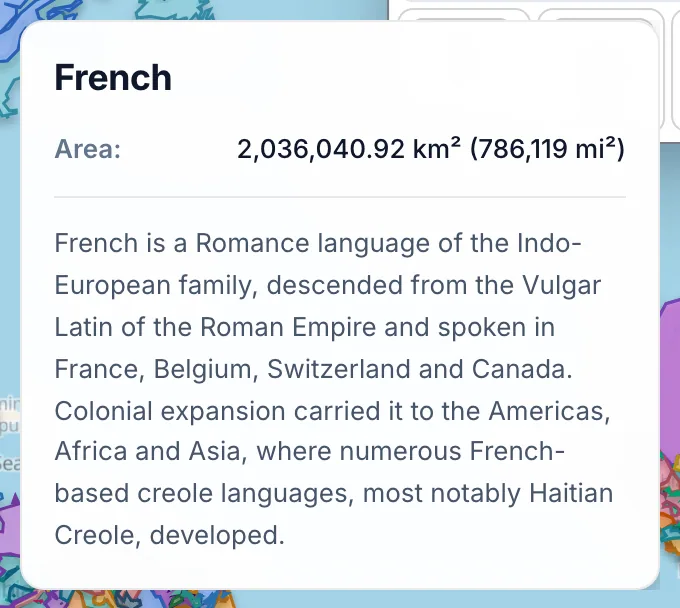
  5. Click the language to open its info card.
Info card of one language on the TrueSize world languages map

The info card of a language.

Load all languages or language families ​

Open the Advanced tab, press Load, and choose one of these options in the Load All dialog:

  • Load All Languages: "Loads the approximate area of every language in the language catalog."
  • Load All Language Families: "Loads the approximate area of every language family in the language catalog."

A language family groups related languages, such as the Indo-European or Afro-Asiatic families. Its area covers the extent of all languages inside it.
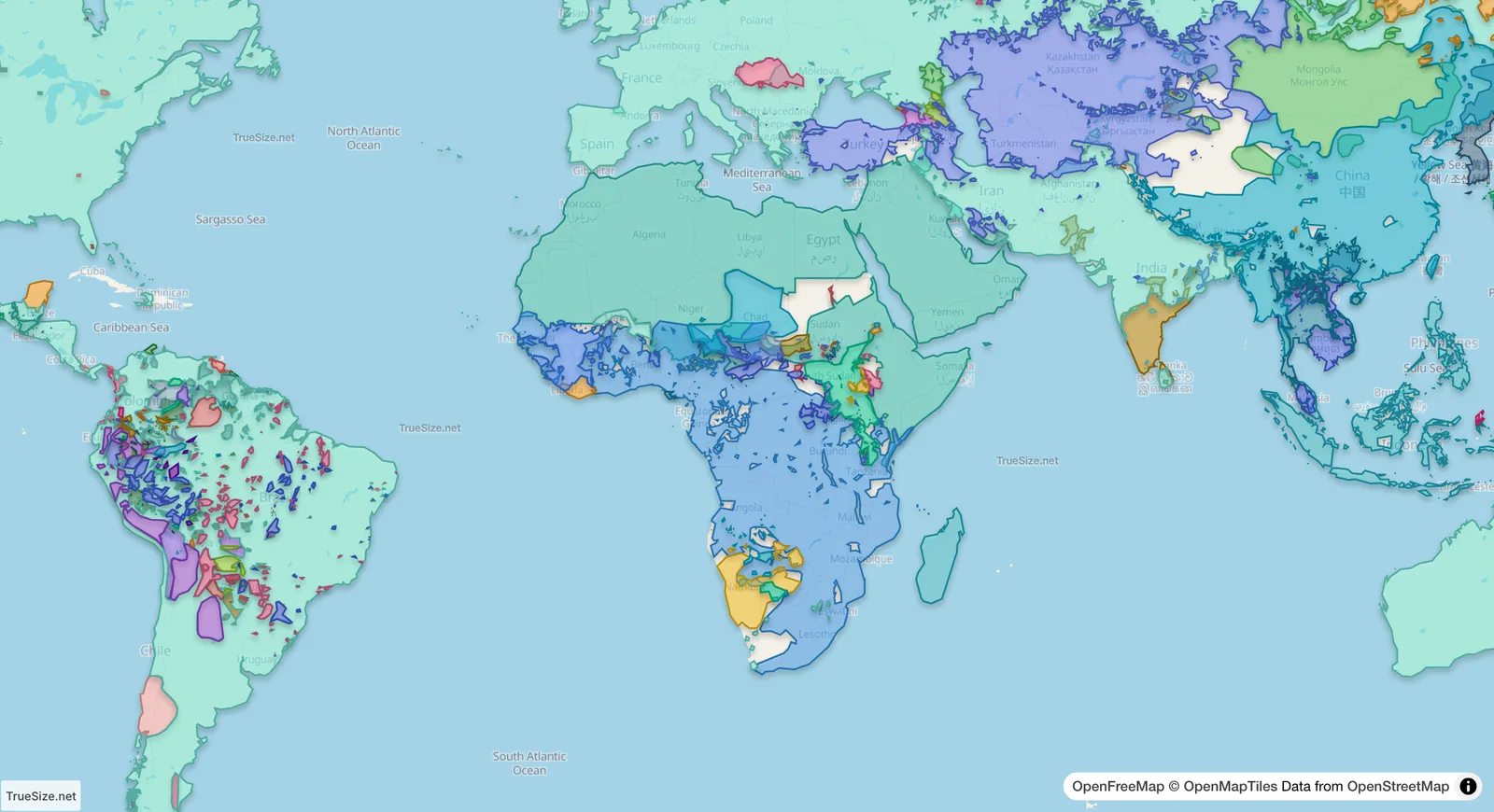
World languages map showing all language families loaded in TrueSize

All language families loaded at once.

Three kinds of areas ​

KindWhat it shows
LanguageWhere a language is spoken today
Language familyThe extent of a whole group of related languages
Official languageThe countries where a language is official

How accurate is it? ​

Language borders are never sharp. People move, many speak several languages, and languages overlap in cities. So these areas are approximate.

  • Where a language is spoken comes from the Atlas of the World's Languages (a printed atlas from 2007), digitized by the Glottography project.
  • Official languages come from Wikipedia's list of official languages by country and territory, also through Glottography.
  • Names, codes and the family tree come from Glottolog, the language catalog.
  • Every language uses its Glottolog code as a stable ID.

The map does not show speaker numbers, and the atlas is older than today's migration patterns. Use the map to get a sense of scale and spread, not as an official record.

Ideas ​

  • Move the area of a widely spoken language over a country to see how much land it covers.
  • Compare a language family with a continent.
  • Use Stats on the Tools tab to see the total area of the languages you loaded.

Where it works ​

Language search and Load All work on the web and in the mobile app.


Next: Live wind, ocean currents and aurora map

Please rotate your device

The map needs portrait orientation on small screens — landscape leaves too little height to work with.