
English
English
Appearance
About 66 million years ago an asteroid roughly 10 km wide struck what is now the Yucatán Peninsula in Mexico. It left the Chicxulub crater, estimated at 150 to 200 km across and now buried under about a kilometer of younger rock. The impact is widely linked to the extinction of the dinosaurs. A 200 km circle covers about 31,000 km², more than the whole of neighboring Belize.
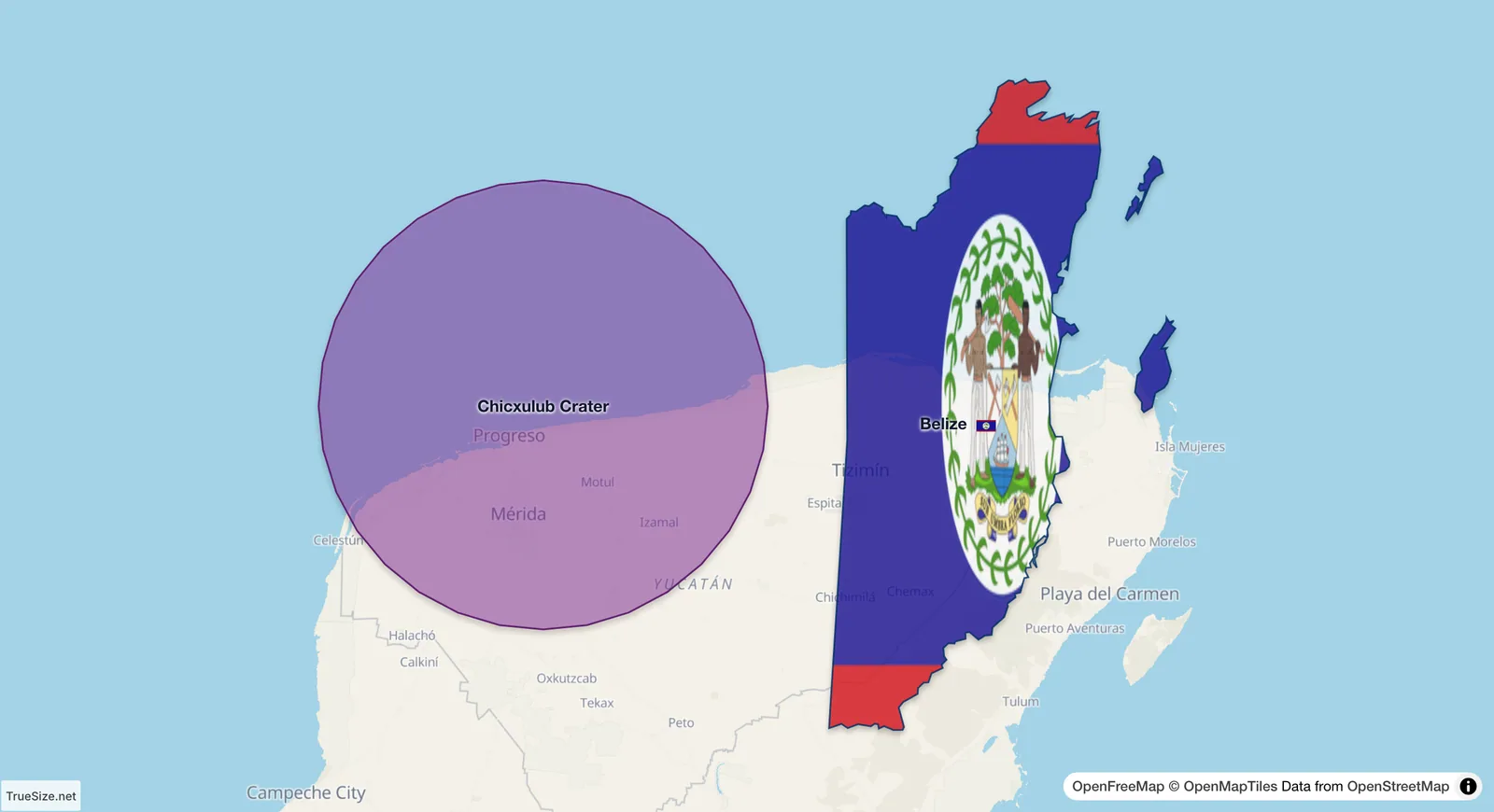
The Chicxulub crater in place on the Yucatán Peninsula and Belize beside it at the same latitude.
| Crater | Where | Diameter (about) | Age (about) |
|---|---|---|---|
| Vredefort | South Africa | 170 to 300 km | 2.02 billion years |
| Chicxulub | Mexico | 150 to 200 km | 66 million years |
| Sudbury | Canada | 130 km | 1.85 billion years |
| Popigai | Russia | 100 km | 36 million years |
| Manicouagan | Canada | 85 to 100 km | 215 million years |
| Acraman | Australia | 90 km | 590 million years |
| Chesapeake Bay | United States | 85 km | 35 million years |
| Meteor Crater | United States | 1.2 km | 50,000 years |
Old craters are worn down or buried, so their original size is an estimate, and published figures differ. In TrueSize each crater is a circle of its published diameter around its published center: the estimated original rim, not what can be seen on the ground today. Where estimates vary widely, as for Vredefort, the card gives the range.
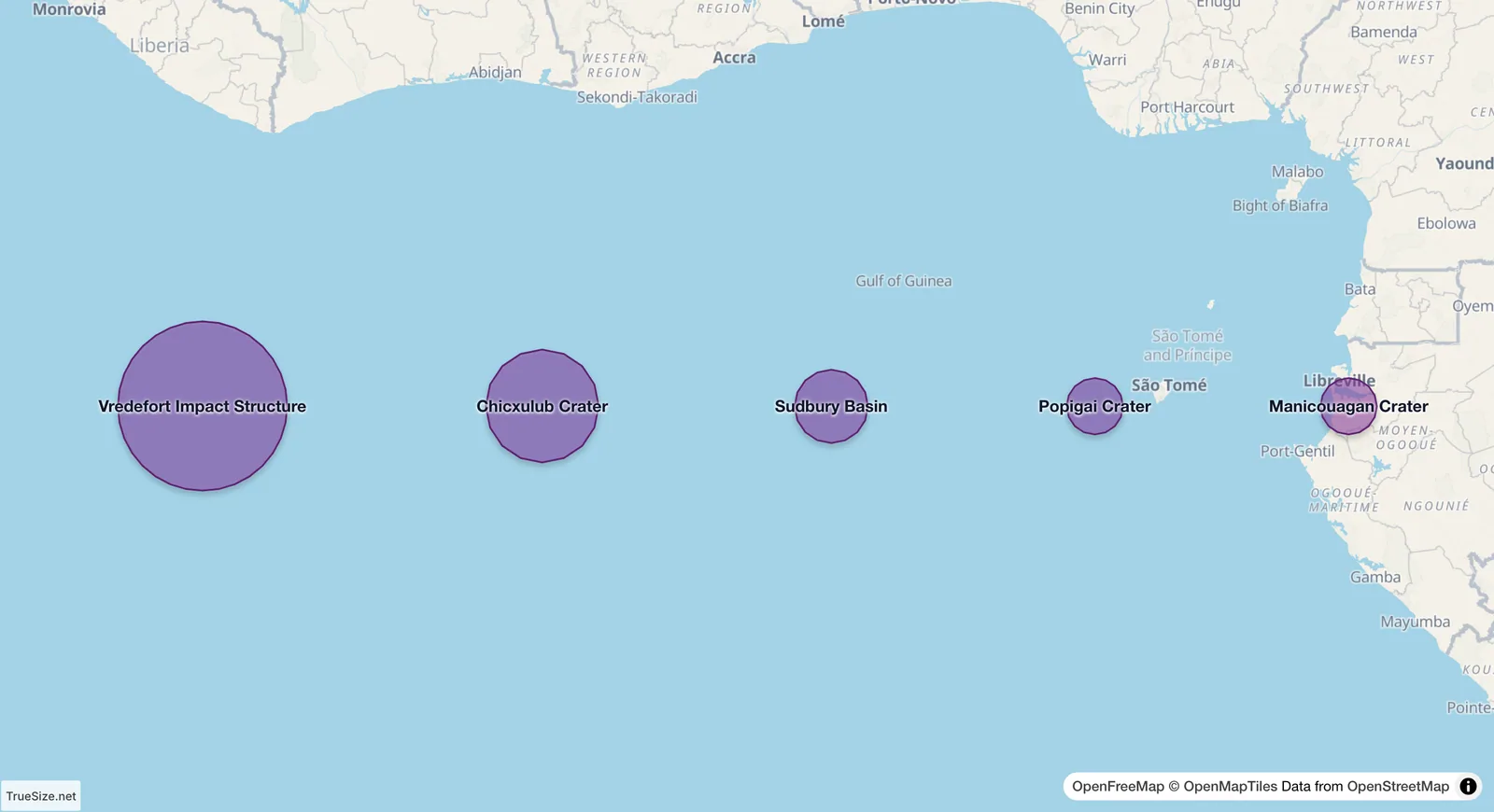
The five largest craters side by side on the equator, from Vredefort (left) to Manicouagan.
Most giant craters are hard to spot. Vredefort has worn down to a ring of hills around a central dome. Manicouagan in Quebec is easy to see from space: a ring-shaped lake about 70 km wide fills its old trough. Small young craters keep their shape best. Meteor Crater in Arizona is about 1.2 km across and 170 m deep, and India's Lonar Lake and Estonia's Kaali craters are also easy to visit.
Please rotate your device
The map needs portrait orientation on small screens — landscape leaves too little height to work with.